Monday, May 2, 2016

Chickpea

Ah, chickpeas, how do I love them? Let me count the ways. I love chickpeas as appetizers; as a snack; as a dip; in a salad or as a main dish.


                                                          Chick pea and its pod called 'çakıldak' or 'kapçık' in Turkish

Chickpeas as a snack are called leblebi in Turkish. Record of the origins of leblebi are scarce, though it is thought to date back to around 1370-90 CE in Turkey. Leblebi is roasted chick peas. There are two different kinds of leblebi: Dehulled leblebi is called 'sarı leblebi' (yellow leblebi) or rarerly, 'Girit leblebi' (Girit-the Island of Crete).


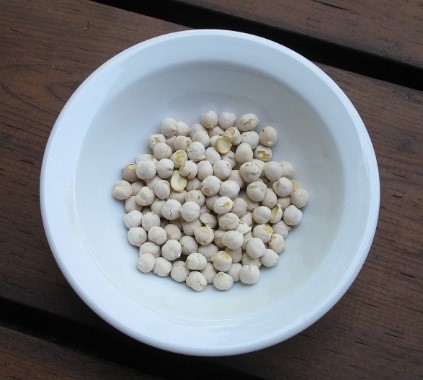
Non-dehulled leblebi is 'beyaz leblebi' (white leblebi) or 'nohut' (the word for chickpea in Turkish).

The first geographically registered (in 2002) leblebi is the Çorum leblebi from the town of Çorum. There are 2 other registered leblebi: Tavşanlı (Kütahya) leblebi (in 2003) and Serinhisar (Denizli) leblebi (in 2009).

Centers that have played a role in the production or are currently producing the most leblebi, starting from south east Turkey and going counter-clock-wise, are Mardin, Kayseri, Kirşehir, Denizli, Çorum, Amasya, Tokat and Erzincan. In Çorum mostly yellow leblebi is produced. White leblebi is produced in the Aegean Region of Turkey.


Evliya Çelebi, (25 March 1611-after 1682) an Ottoman Turk who travelled through the territory of the Ottoman Empire and neighboring lands over a period of forty years, recording his commentary in a travelogue called Seyâhatnâme tells that in the 17th century Istanbul, leblebi was produced and consumed in abundance. There were 100 shops and 400 workers making leblebi. The population of the city at the time is estimated to be 700,000-800,000.

The word leblebi may have come from the Arabic word 'leblab', a kind of ivy with edible seeds, thus 'leblebi' is 'made from leblab' or from the Persian 'leb', meaning lip, and suffix-i, 'of lips', thus leblebi is ‘for lips’ perhaps.


Cicer is a genus of the legume family Fabaceae (formerly Leguminosae), subfamily Faboideae and the only genus found in tribe Cicereae. Its best-known and only domesticated member is Cicer arietinum, the chickpea. The word legume means a plant in the family Fabaceae, or the fruit or seed of such a plant. This variety of plants (lately called pulses) have pods that contain seeds. Beans and peas are examples of legumes. Legumes are used for food, feed or as soil-improving crops due to their root characteristic.


The delicate chickpea flowers are produced singly or in pairs and can be white, pink, purple or blue in color.

The chickpea is thought to have originated in Turkey, Syria and Iran (http://www.kew.org/science-conservation/plants-fungi/cicer-arietinum-chickpea). It is one of the earliest cultivated legumes: 7,500-year-old remains have been found in the Middle East. Domesticated chickpeas have been found in the aceramic levels (without pottery) of Jericho and in Çayönü in Turkey. They were in Neolithic pottery at Hacılar, Turkey. They were found in the late Neolithic period (about 3500 BCE) at sites in Greece. In southern France, Mesolithic layers in a cave at L'Abeurador, Aude (south-central France) have yielded wild chickpeas carbon dated around 6790 BCE.

Chickpeas are mentioned in Charlemagne's Capitulare de villis (about 800 CE). Albertus Magnus, a 13th century Bishop mentions red, white, and black varieties in his writings.

Wikipedia lists the following kinds of chickpeas:
'Desi' which has small, darker seeds and a rough coat is grown mostly in India and other parts of the Indian subcontinent, as well as in Ethiopia, Mexico, and Iran. 'Desi' is probably the earliest variety because it closely resembles seeds found on archaeological sites and the wild ancestor of domesticated chickpeas, which only grows in southeast Turkey, where it is believed to have originated.

'Bambai' chickpeas are also dark but slightly larger than 'Desi'.

'Kabuli' is lighter colored, larger, and with a smoother coat, and is mainly grown in the Mediterranean, Southern Europe, Northern Africa, South America, and the Indian subcontinent.

An uncommon black chickpea, ceci neri, is grown only in Apulia, in southeastern Italy. It is larger and darker than the 'Desi' variety.

Green chickpeas are common in India.


Chickpeas used for leblebi are selected for shape, size, color, and harvesting time, and vary by cultivar. Generally, large-seeded (8 –9 mm in diameter), lighter-colored, round, and smooth surfaced kabuli chickpeas are preferred; a thick seed coat and hull, easy to remove from the kernel is requisite. Harvesting time determines the tempering process and quality of leblebi; chickpeas are cleaned and classified by size, with undeveloped, damaged, shrunken, and broken chickpeas discarded (https://en.wikipedia.org/wiki/Leblebi).

Leblebi is produced through a long and laborious process. To begin with, the chickpeas are heated (tempered) in special ovens  3 times on 3 separate days. After the third heating they are spread out to rest. This process takes approximately 15-20 days.

The night before leblebi is going to be made the chickpeas are dampened. The following day they are warmed in the special pan and lightly pressed with what is called a ‘mafrak’ (also known as tokmak or varak, a cylindrical piece of preferably poplar wood that is at least 30 cm in diameter) to get the skins off. During this process some chickpeas brake into two halves. These are separated by the use of a sieve from the whole chickpeas.

‘The broken leblebi’ are turned into leblebi flour. If the rest of the leblebi is roasted one more time little black specks appear on the chickpeas. They are then called ‘çifte kavrulmuş’-‘double roasted’ which is an expression often used within the Turkish food industry. Tea biscuits or Turkish delight-lokum can be double roasted, for instance.

Chickpea flour is gluten free and therefore can be consumed by people who have Celiac disease.

There is also a wide variety of types of leblebi that I don’t care for. It is said that there can be up to forty kinds of leblebi such as chocolate covered, sugar coated, peppered, candied, with mastic, with clove, etc. Leblebi has been introduced to North Africa, the Middle East, Europe and even North America.


The Armenian-Turkish composer Dikran Tchouhadjian (1837-1898) composed an operetta titled Leblebidji Hor-Hor Agha (The Chickpea Vendor Hor-Hor Agha) in 1875.

Chickpea and beef stew goes well with rice.

                          
For a tasty hummus, all you need is chickpeas, tahini (paste made from toasted, hulled, ground sesame seeds), garlic, sea salt, extra virgin olive oil and lemon juice.

Chickpeas are a good source of fiber, protein and iron making them desirable in a vegetarian diet. They have a mild, subtle taste that pairs well with many other ingredients.

Wikipedia informs us that the name chickpea traces back through the French chiche to cicer, Latin for 'chickpea'. The Oxford English Dictionary lists a 1548 citation that reads, "Cicer may be named in English Cich, or ciche pease, after the Frenche tongue." The dictionary cites chick-pea in the mid-18th century; the original word in English taken directly from French was chich, found in print in English in 1388.

The word garbanzo came first to American English as garvance in the 17th century, from an alteration of the Old Spanish word arvanço, being gradually anglicized to calavance. The current form garbanzo comes directly from modern Spanish. It’s been suggested that the origin of the word may derive from a Greek word or possibly, from two Basque (a non-Indo-European tongue) words forming a compound meaning dry seed.


I must say that chickpea coffee would not make the list of how I love chickpeas. In the early fifties I remember the scarcity of certain items. The lack of one of these, coloring pencils, concerned me in particular until the stationary my aunt frequented to get me story books received several boxes of them. About the lack of good coffee in those days I was informed later. Ground chickpeas would be added to the little amount of coffee there was and boiled. How could this satisfy any true coffee drinker? I guess at a time when there was no alternative they had do make do.

In 1793, ground-roast chickpeas were noted by a German writer as a substitute for coffee. In the First World War, they were grown for this use in some areas of Germany.

People still seem to brew chickpeas instead of coffee around the world. All that needs to be done is roast some chickpeas in a 300 degree oven until they're the color of roasted coffee beans, then grind the nuggets to the consistency of percolator-type coffee. I wouldn’t know.


                                                                                           Dry chickpeas

Monday, April 4, 2016

Lamium purpureum; a flower for my mother

In April 2015, as my mother lay in bed for the last ten weeks of her life, spring brought flowers to the park lawns, empty lots and road sides in Istanbul. One in particular, a small plant with purplish pink flowers that I had not paid much attention to before, was abundant that spring. I dedicated it to my mother’s spirit and observed it for much needed solace.


Lamium purpureum is an annual plant that flowers from April to November. It carpets huge areas and grows to be quite lush in fertile soil. It is a short lived plant but it will grow and flower even in the winter with mild temperatures. It is placed in the family Lamiaceae, the mint family. It grows to 20-30 cm tall.

                                             http://commons.wikimedia.org/wiki/File:Cleaned-Illustration_Lamium_purpureum.jpg

Being a member of the mint family we see that its stem is square or four sided instead of round or cylindrical and the stem and the leaves are covered in hairy down. The leaves are simple and opposite.


The leaves are green at the bottom and have a purplish shade at the top of the plant; they are 2-4 cm long and broad, with a 1-2 cm petiole (leaf stalk), and wavy to serrated margins.

Many species in the mint family are also aromatic. Basil, rosemary, lavender, marjoram, thyme, savory sage, together with mint, peppermint and spearmint are from the same family as L. purpureum. There are a handful of other plants with square stems and opposite leaves as the Mints but those plants are found in the Loosestrife, Verbena and Stinging Nettle families and none of them smell minty and spicy. The common name for L. purpureum is ‘red dead-nettle’ indicating it’s similar in look to nettle but that it does not sting.

The flowers are special. They have five sepals, parts of the flower that protect the bud and support the petals when the flower is in bloom. The sepals are fused together so that only the tips of them are separate. The five petals are also fused together but in an asymmetrical or irregular way. L. purpureum has a top hood like petal, two short ones on the sides and two lower lip petals. Typically, inside the flower there are four stamens, the reproductive organs, with one pair longer than the others.


The flowers are zygomorphic which means having floral parts unequal in size or form so that it is possible to divide the flower into essentially symmetrical halves by only one longitudinal plane passing through the axis.

The more I learned about this plant the more I knew how well it suited my mother. My beautiful mother did not have high ambitions other than to be with her family. She was a woman of simple tastes. She knew to waste not and want not. She loved nature and she always had cut flowers in her vases. She would have enjoyed this useful and unassuming plant with the small pink flowers in her home.

Any member of the Mint family can be safely eaten. With L. purpureum the entire plant is edible. The nature and botany author Thomas J. Elpel tells us that the plant tastes a little grassy but the flavor is rather mild. The plant is highly nutritious, abundant in iron, vitamins, and fiber. The oil in the seeds is high in antioxidants. And the bruised leaves can be applied to external cuts and wounds to stop bleeding and aid in healing. Elpel recommends that the best way to eat large quantities of this plant is to blend it into a smoothie.

My mother was blessed with an abundance of fruit and vegetables in her diet since her childhood. She ate a rich variety of natural foods that she cooked herself. She did not waste. I wish, together, we could have tried out L. purpureum smoothies.


The flowers are loaded with nectar. This allows bees to gather the nectar for food when few other nectar sources are available. It is also a prominent source of pollen for bees in the spring when bees need the pollen as protein to build up their nest. In turn, the flowers are pollinated by bees.

The plant has medicinal properties. The whole plant is said to be astringent, styptic, diaphoretic, diuretic and purgative which all sound like remedies that help to detoxify the body. One way of consuming the plant is to add one tea spoon full of chopped L. purpureum to a glass of water in a pot and bring it to a boil, steep it until it cools and strain. Drink it three times a day between meals. The drink can be sweetened with honey.

27 species of Lamium are found in Turkey. L. purpureum is a species which has spread all over the world. As with many plants, outside of its native range, it is a common weed of cultivated areas; it is listed as an invasive species in some parts of North America.


One of many quotes from Vincent Van Gogh goes, “If you truly love nature, you will find beauty everywhere”. My mother was a tolerant, peace loving and graceful woman who was always appreciative of what life had presented her. I believe her true love of nature helped her see beauty everywhere. 
   
A picture of my mother taken in 1974

Tuesday, March 1, 2016

Centaurea solstitialis

One explanation for the Latin name of this plant is like this: "Centaurea comes from the Greek word centaur that means spearman or piercer." Centaurs, half man-half horse creatures in mythology were, actually, quite hostile to humans.  Their weapon was the bow and arrow.

"The Latin term solstitium* refers to the summer solstice or the longest day of the year, and -alis means ‘pertaining to’. Thus, the specific epithet solstitialis means pertaining to the longest day of the year. This is in reference to the ability of Centaurea solstitialis to flower very late into the summer.”* (http://wiki.bugwood.org/Centaurea_solstitialis)

                                                     Pressed flowerhead of C. solstitialis that I picked couple of years ago

C. solstitialis happens to be my favorite thistle. Commonly called yellow star thistle or golden star thistle, it is placed in the family Asteraceae. Thistle is the common name of a group of flowering plants characteristically with sharp prickles. Prickles often occur all over thistles, on the surface of the stem and also flat parts of leaves. These are an adaptation that protects the plant against herbivorous animals, discouraging them from feeding on the plant.


Still, sheep, goats or cattle are effective in reducing C. solstitialis seed production by grazing after plants have bolted (opened prematurely) but before the spines form. Goats will eat star thistle even in the spiny stage.

C. solstitialis is considered a weed even on its native habitat that is believed to be Eurasia. It is native to the Balkans, Asia Minor, the Middle East and southern Europe. Yet, it is kept in check by its natural herbivore enemies and other plants that have co-evolved with it. In many of the non-native regions it has been introduced where the natural biological controls do not exist, it has become an invasive species and noxious weed.


C. solstitialis has been introduced in several parts of the world, including Australia, Argentina, Chile, and the USA. Its introduction in North America is said to have occurred as a seed contaminant in Chilean grown alfalfa seed, also known as Chilean clover. C. solstitialis was first introduced to Chile from Spain in the 1600s and from Chile to California at the time of the gold rush after 1848.

C. solstitialis is actually a winter annual (sometimes biennial) that grows up to a meter high. It can form dense impenetrable ‘stands’ displacing desirable vegetation in natural areas, rangelands (lands grazed by domestic livestock or wild animals), and other places. It is best adapted to open grasslands with deep, well-drained soils and wet winters and dry summers. Plants usually senesce (age and die) in late summer or fall. The majority of seed dispersal occurs soon after dried flowers are detached from the heads. The spines are shed but the chaff (dense fuzzy gray hairs) remains in the involucre (a group of one or more protective whorls of bracts beneath a flower or flower cluster). The plants form dense thatches in this state.

My favorite thistle is not all trouble, though. Not every aspect of Centaurea solstitialis or yellow star thistle is detrimental.

Yellow star thistle is a valuable source of pollen for pollinators. It is a major source of nectar for many butterflies. It is also regarded as an important honey source plant.

Similar to many plants classified as 'weeds', it establishes itself quickly and protects and restores soil that has been left exposed by natural and human-caused disturbances. It populates ground that has been abused; dried up, compacted, or scraped clean. Being a plant with a tap root system, it has a crucial role in restoring soil fertility by bringing up vital micronutrients such as minerals. In a plant with a taproot system, the taproot is the largest, most central, and most dominant root from which other roots sprout laterally. Typically a taproot is somewhat straight and very thick, is tapering in shape, and grows directly downward. It is difficult to remove a taproot from the ground but the system makes up for the inconvenience by breaking up compacted subsoils. “This improves infiltration of moisture into the soil, reduces surface runoff and helps control erosion.” (Rural Development through Carbon Finance, Sebastien M. Scholz-https://books.google.ca/books?isbn=3631592507)

Yellow star thistle is very pretty to look at too.


________________________

*The word 'solstice' translates from the Latin solstitium, meaning 'stopped sun,' in reference to the winter and summer solstices where the Sun's daily arc across the sky reaches its extreme southerly and northerly limits.

Monday, February 1, 2016

Capers

I like my food plain and not particularly seasoned. I don’t like mixing too many spices or herbs. Salt and pepper will do just fine most of the time. With certain vegetables I like parsley and with others I like dill weed. Some dishes might call for a little bit of oregano. I don’t care for most other herbs so much. I feel that they overpower the taste of the actual meal. I’ve only recently begun to enjoy capers with smoked salmon. I thought that there could be no need to have capers with any food I was having. I didn’t know what capers were either.

When I was a child I remember going to a laid-back al fresco restaurant with my parents. The evenings were warm under the stars. The adult conversation was calming. I chose to get up from the table and explore the shrubby boundaries of the spot. One interesting shrub that impressed me with its flowers later prevailed among the memories of those evenings.


I now know that it was the caper bush. Capers are the unopened flower buds of the caper bush, Capparis spinosa in the family Capparaceae.


                            Otto Wilhelm Thomé (1840-1925) - Flora von Deutschland Österreich und der Schweiz

The caper bush, C. spinosa, grows all around the Mediterranean. Some also grow in Asia and in Australia. This sprawling, perennial, evergreen shrub typically grows to a meter wide. It is a rupicolous species which means it grows in dry and hostile conditions including sandy or gravelly soils, rocky hillsides, cliffs, stone walls and rock crevices. It is thought that the caper bush may have originated in the tropics, and later been naturalized to the Mediterranean basin.


The plant has rounded, fleshy leaves and large white to pinkish-white flowers with purple stamens, the pollen producing reproductive organ of a flower, usually consisting of filaments.

                                (http://www.earthporm.com/probably-idea-favorite-fruits-vegetables-spices-grow/)

Flowers only last one day, but bloom profusely from May to early autumn. Flower buds are picked prior to opening when still tight, washed in salt water to remove grit and pickled in brine, vinegar or wine. Buds are often picked daily by hand and they are categorized by their size. The youngest smaller buds have the best quality.

The leaf stipules, often leaflike appendages at the base of a leafstalk, develop into a pair of sharp hooked little spines on this plant. Hands are easily scratched when harvesting capers and clothing may catch on the hooked spines.


“The economic importance of the caper plant led to a significant increase in both the area under cultivation and production levels during the late 1980s. The main production areas are in harsh environments found in Morocco, the southeastern Iberian Peninsula, Turkey, and the Italian islands of Pantelleria and Aeolian Islands, especially Salina. In Australia, capers are grown in both Western and South Australia such as on the dry rocky slopes above the Murray River with no extra irrigation. In the USA, caper bush thrives in coastal California, and they’re grown successfully in South Africa and New Zealand as well.” (https://en.wikipedia.org/wiki/Caper)

The flower buds not picked bloom and produce caper berries, the fruit of the shrub. The oblong, multi-seeded caper berries are edible also. The caper berries are used as a seasoning in pickled form just as the capers. They are larger than capers and they are sold with the stems still attached.

caper berry
The leaves of the caper bush are edible too. They can be used as salad greens.

Capers are often served with cold smoked salmon. Culinary use of capers extends back in history for thousands of years. They are said to be mentioned as a food in the Sumerian epic of Gilgamesh which dates back to before 2000 B.C.


Monday, January 4, 2016

Oh, that weed!

When I decided to write about my favorite ‘weed’, I first had to find out its name. I asked around and people said, ‘oh, that weed, its everywhere.’ ‘Oh, I see that all the time.’ ‘Isn’t that such and such’, as they offered an incorrect name for it.

The samples I used to see and still see in Turkey are scraggly due to the warmer climate with lots of sunshine. This road side ‘weed’ has always been on my mind and as a child the seed heads reminded me of busy spiders.


In the end, invariably, the internet provided the information I was looking for. After eliminating Andropogon gerardii and Cynodon dactylon (common name Bermuda grass) that resemble the plant I had in mind, the ‘weed’ turned out to be actually an annual grass that originated in Europe. Crabgrass, as it is known by its common name, the species I’m familiar with has the complicated binomial name Digitaria ischaemum and it belongs in the family Poaceae (also called Gramineae or true grasses).

            Andropogon gerardii    Cynodon dactylon

Digitaria ischaemum is a species of crabgrass also known by the common names smooth crabgrass and small crabgrass. It is native to Europe and Asia, but it is known throughout much of the warm temperate world as an introduced species and often a common roadside and garden weed. It has smooth stems and an average height of 15cm. It is a warm season annual that grows from seeds.

Digitaria comes from the Latin word 'digitus', meaning finger and ischaemum comes from the Greek ‘ischaimon’ or ‘ischaemos’ meaning styptic (tendency to check bleeding by contracting the tissues or blood vessels; hemostatic) for its ability to stop bleeding. I did not find anything else on this property.


Digitaria ischaemum

A similar crabgrass, Digitaria sanguinalis, on the other hand, is known by the common names hairy crabgrass, large crabgrass and purple crabgrass. This one is known nearly worldwide as a common weed. It is found throughout the United States and southern Canada. This variety has hairy stems and grows much taller. It is used as animal fodder, and the seeds are edible and have been used as a grain.


I photographed the above crabgrass in Canada last summer. I can not tell which species it is.


There are 300 species of crabgrass. Crab grass often gets confused with other weeds. Sometimes the names crabgrass, devil grass, and quack grass, plus Bermuda grass, are used interchangeably among all those plants.

Crabgrass is one of the plants that I really wanted to write about here once I got to figure out its proper name. I’m thinking of many more plants that I have known since I was a child. There are also the ones I remembered when I began to intently seek out plants. Then, there are the ones I notice for the first time as I look around more attentively and see many different everyday plants everywhere. 

I do not want to stop writing about plants, but from now on I would like to do it at a slower pace. I will tell about one plant each month and if you happen to read and enjoy one of my posts drop me a line, please.

Monday, December 28, 2015

Milkweed

We were driving from Ottawa to Montreal on a late October (2013) Sunday when I noticed cottony looking plants along the highway. We pulled over and I collected a few stems with the dry, half open seed pots attached. I took their photographs when we reached home. What beautiful images I had! When I looked it up I found out that this was milkweed. Had I not first seen  it in its  dry state, I would not have noticed milkweed and learned about it. This was my first discovery of a native Canadian plant.


Commonly known as milkweed or silkweed, Asclepias syriaca is native to Southern Canada and much of the conterminous (having a common border-I learned a new word) U.S. east of the Rocky Mountains. Too bad the species name is Syriaca meaning ‘of Syria’ which it is not. Carl Linneaus or Carl von Linné, as he was known later, named it in the mid-1700s but he confused it with the milkweed from the Orient. In botany, a name first assigned is unchangeable, regardless of errors in derivation or spelling.

A. syriaca is in the milkweed subfamily Asclepiadoideae (formerly in the family Asclepiadace) of the family Apocynaceae. Asclepias comes from Asklepios, the Greek god of medicine, for the medicinal properties of the plant.

A. syriaca is a species of flowering perennial herb. It grows in sandy soils and other kinds of soils in sunny areas starting from a rhizome and reaches a height of 60 to 120 cm. It was one of the earliest North American species described in the French physician and botanist Jacques-Philippe Cornut’s (1606-1651) 1635 work Canadensium Plantarum Historia.

Milkweed flowers bloom from June to August. The fragrant, nectariferous-nectar producing flowers occur in compound cymes. The flowers have five petals and they are rose to purple in color. Individual flowers are about 1 cm in diameter.


compound cyme


The leaves are broad, elliptical and opposite. The large leaves have very short petioles (the stalk by which the leaf is attached to a stem) and velvety undersides.


The fruit are green pods or follicles which turn brown before bursting open to let out beautiful fluffy seeds like the ones that drew my attention.


In late summer and early fall the seed pods mature and dry out, they crack open and release many disc shaped brown seeds borne by the wind on a plume of white silky hairs. The seeds are neatly packed in overlapping rows. One name for the filament like hairs they are attached to is pappus. The name pappus derives from the Greek word pappos, Latin pappus, meaning ‘old man’.


The pappus function as a ‘parachute’ which enables the seed to be carried by the wind.


The leaves of the milkweed are the only food source for the Monarch butterfly larvae (caterpillars). Milkweed flowers are a nectar source for many butterflies but especially the Monarchs. Without milkweed we would not have these beautiful butterflies.


 Photograph: Aydın Örstan, Monarch butterfly at Black Hill Regional Park, 20930 Lake Ridge Drive, Boyds, Maryland, USA
 
I am learning that milkweed is also an important nectar source for many species of insects such as the native bees, wasps, and other nectar-seeking insects. The plant is a food source for a variety of herbivorous insects, including numerous beetles and moths, specialized to feed on the plant despite its chemical defenses. Milkweeds are a shelter and hiding place for other species as well. Yellow Jacket wasps eat bees and flies which get trapped in the flowers, and crab spiders ambush tasty visitors. Milkweed Bugs, and Milkweed Leaf Beetles only eat milkweed, and could not survive without it.

Yet, the plant is on Ontario’s noxious weeds list. All parts of the milkweed plant produce white latex when broken. The sap has poisons in it, called cardiac glycosides. These are similar to digitalis or digoxin, common heart medications used in both human and veterinary medicine. Consumed in large quantities milkweed has poisoned livestock.

Some animals can eat the glycosides and not be harmed. The Monarch butterfly caterpillars eat the leaves of milkweed and store its toxic compounds, which makes them unpalatable to predators. Even after the caterpillars change into adult butterflies, they keep the glycosides in their body.


Jack Sanders, author of the book titled The Secrets of Wildflowers (2003) provides interesting information on milkweed. He also shares my feelings of joy and amazement. He writes: “Milkweeds are among the great toys of nature, known to almost any kid who grows up in the country.” He quotes naturalist F. Schuyler Mathew (1894): “The common milkweed needs no introduction. Its pretty pods are familiar to every child, who treasures them until the time comes when the place in which they are stowed away is one mass of bewildering, unmanageable fluff.”

I could easily be that child had I known milkweed seeds.

To give nature a hand, milkweeds can be propagated from seeds, cuttings, and, in some cases, from root divisions.