Monday, September 28, 2015

Campanula tomentosa

Many different campanula are endemic to Turkey.


                     Campanula tomentosa (as syn. Campanula ephesia) plate 6715 in: Curtis's Bot. Magazine, vol. 143, (1917)

“In the year 2000 about 9300 species of vascular plants were known for the area of the Turkish Republic. The significance of this number becomes evident if we compare it with Europe as a whole, containing about 24% more species (about 11500), distributed over a thirteen times larger area.” (http://en.wikipedia.org/wiki/Flora_and_Vegetation_of_Turkey)

I was aware that the area of the Turkish Republic was rich in endemic flora. I did not know about Peter Hadland Davis (1918-1992), the British botanist and his life’s work, The Flora of Turkey and the East Aegean Islands. In 1950 he began the research project. In 1952 he received his PhD on taxonomy of Middle East flora from the University of Edinburgh. In 1961 he intensified his efforts to complete The Flora of Turkey, which was finally completed in 1985. (http://en.wikipedia.org/wiki/Peter_Hadland_Davis)

One web site about the book explains: “This monumental series presents the richness and diversity of Turkish flora in nine volumes (1966-85), plus two supplements (1988; 2001). It is a major contribution to the floristic study of South West Asia and the eastern Mediterranean region.”

The work was later co-authored. I believe there is a Volume 10 now.

The most important reasons for Turkey’s high plant biodiversity are relatively high proportion of endemics and a high climatic and edaphic (soil) variety.

“DAVIS & al. (1988) calculated that nearly one third of Turkish plant species (30.6%) is endemic to Turkey and the nearby Aegean Islands. For Austria the respective value is meagre 1.56% and for the British Isles it is still lower. Moreover, none of the endemic British species is taxonomically remote from a non-endemic species. One might unite all the endemic species with none-endemic ones, thus concluding endemism to be 0 % on the British Isles. On the other hand, rates of endemism are also highly dependent on the surfaces of compared areas and their delimitations. In order to achieve better comparable data one might unite the surfaces of Germany and France, thus obtaining an even larger area than Turkey. But the estimated proportion of endemics still would remain much lower, with Germany alone having about the same low proportion as Austria.

One reason for this relative importance of endemism in the Turkish flora is the mountainous and at the same time rather strongly fragmented surface of Anatolia. Since Darwin we know that geographic isolation between islands or separated mountains is an important means of speciation, leading to high spatial diversity. For Anatolia this assumption is confirmed by concentrations of endemism on highly isolated and relatively old massifs as Uludağ or Ilgaz Dağ, whereas very young volcanic cones as Erciyes Dağ or Hasan Dağ are surprisingly poor in endemics.” (http://en.wikipedia.org/wiki/Flora_and_vegetation_of_Turkey)

Campanula is one of several genera in the family Campanulaceae with the common name bellflower. It takes both its common and its scientific name from its bell-shaped flowers. Campanula is Latin for ‘little bell’.

The genus includes over 500 species and several subspecies, distributed across the temperate and subtropical regions of the Northern Hemisphere, with the highest diversity in the Mediterranean region east to the Caucasus.

The species include annual, biennial and perennial plants, and vary in habit from dwarf arctic and alpine species under 5 cm high, to large temperate grassland and woodland species growing to 2 meters tall.

The flowers are mostly blue to purple, sometimes white or pink. The fruit is a capsule containing numerous small seeds.

Campanula tomentosa is one of many pretty campanula species endemic to Turkey. C. tomentosa is almost a mounding looking campanula with shorter stems and bigger robust flowers of a lovely pastel blue color. Tomentosa is derived from the Latin meaning ‘covered in hairs’.


                                                     Photograph: http://www.agaclar.net/galeri/files/3951-1146135703.jpg


I don’t get the chance these days to go where C. tomentosa grows. It is found mostly on the Dilek Peninsula National Park jutting to the Aegean Sea. This place is right by the delta of the Meander River. The ancient city of Ephesus where the plant has been seen is not too far away either. A synonymous name for C. tomentosa is C. ephesia which means a native or inhabitant of ancient Ephesus.


Another species in the genus Campanula, Campanula rotundifolia is a perennial flowering plant in the Campanulaceae family native to temperate regions of the Northern Hemisphere. Common names for it are harebell and bluebell.


I took these photographs at the Geneva Botanical Garden in the summer of 2014. Campanula rotundifolia is a perennial species of flowering plant spreading by seed and rhizomes. The flowers usually have five pale to mid violet-blue petals fused together into a bell shape about 12-30 mm long with pointed green sepals at the base. The petal lobes are triangular and curve outwards. The seeds are produced in a capsule about 3-4 mm diameter and are released by pores at the base of the capsule. As with many other Campanulas, all parts of the plant exude white latex when injured or broken.


                                    From Thomé, Prof. Dr. Otto Wilhelm, Flora von Deutschland Österreich und der Schweiz, 1885

The flowering period is long, and varies by location. The flowers are pollinated by bees, but can self-pollinate.

The photographs below are from a visit to Ephesus, Turkey in the summer of 1986. I never came across C. tomentosa myself.


Monday, September 21, 2015

Honeysuckle

“Every honey bee fills with jealousy
When they see you out with me
I don't blame them
Goodness knows
Honeysuckle rose…..”

Honeysuckle Rose composed by Fats Waller in 1929, lyrics by Andy Razaf for the show Load of Coal.

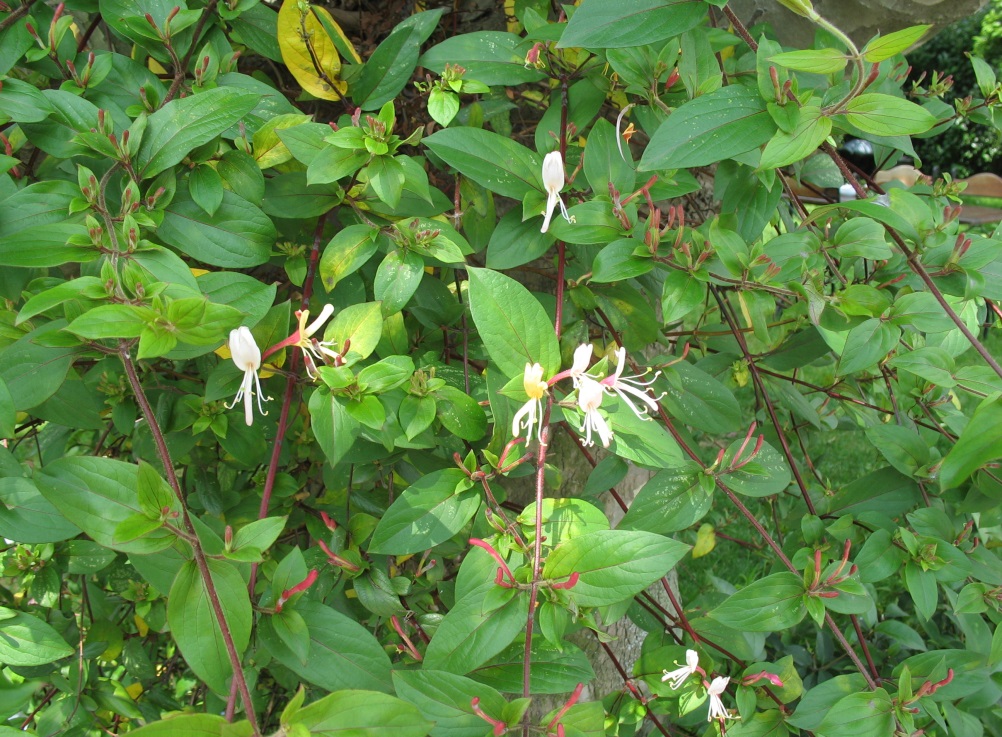
Honeysuckle is a flower that is featured in song, poetry and film. There are girls (Honeysuckle Weeks, British film star) and streets named after the honeysuckle.


                                                      Honeysuckle flowers are sweet smelling especially during the night.

“Many of the species have sweetly-scented tubular, two-lipped flowers that are creamy white or yellowish. They produce a sweet, edible nectar and most flowers are borne in clusters. There are shrubby and vining sorts of honeysuckle.” (http://en.wikipedia.org/wiki/Honeysuckle)

A flowering plant in the family Caprifoliaceae, the species Lonicera periclymenum is native to much of Europe. The name Lonicera comes from Adam Lonicer, a Renaissance botanist. “Growing to 7 m or more in height, it is a vigorous evergreen twining climber. It is found as far north as southern Norway and Sweden. It is often found in woodland or in hedgerows or scrubland. The plant is usually pollinated by moths or long-tongued bees.” (http://en.wikipedia.org/wiki/Lonicera_periclymenum)

“I know a bank where the wild thyme blows
Where oxlips and the nodding violet grows
Quite over-canopied with luscious woodbine
With sweet musk-roses and with eglantine’’

William Shakespeare, A Midsummer Night's Dream (woodbine is another common name for the plant)


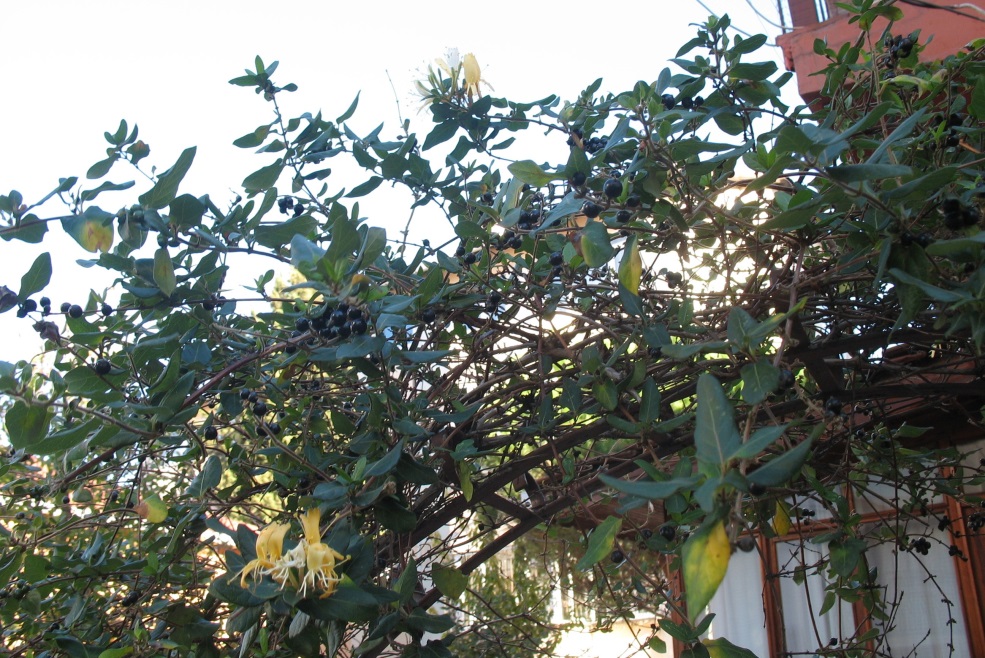
The fruit is usually a red, blue or black spherical berry containing several seeds; in most species the berries are mildly poisonous. Most honeysuckle berries attract wildlife which leads to invasive spreading outside of their home ranges. The leaves are opposite, simple oval, 1–10 cm long.


My own name is not a flowery name but a musical one. Beste means the melody as opposed to the lyrics of a piece of musical work.  I may have been the first Beste in Turkey. I have not heard of anyone else named Beste in my generation, whereas there are many Bestes now all younger than me. My father came up with the name after reading the poem Ses (sound, voice in Turkish) by Yahya Kemal Beyatlı (1884-1958). In a part of the poem, the poet describes hearing a ‘beste’ rising from the Bosphorus in Istanbul.

Bir lâhzada bir pancur açılmış gibi yazdan
 Bir bestenin engin sesi yükseldi Boğaz’dan.
 Coşmuş gene bir aşkın uzak hatırasiyle,
 Aksetti uyanmış tepelerden sırasiyle,
 Dağ dağ o güzel ses bütün etrafı gezindi;
 Görmüş ve geçirmiş denizin kalbine sindi.

Told in my own words that will not do justice to what the poet expressed:
As if a summer shutter opened, the exalted sound of a ‘beste’ rose from the Bosphorus. Elated yet again with the old memory of a love, it reflected back from the awakened hills one by one. That lovely sound hung about each mountain. It permeated to the all-knowing heart of the sea.

                   
                                                                                             Honeysuckle on my brother Aydın’s front lawn in Maryland, USA, winter of 2013


                                           This looks like a honeysuckle kind of street.

Monday, September 14, 2015

Philadelphus


Each time I see a Philadelphus shrub such as the one in the picture above I think of my dad, for he was the one who pointed out the plant and told me its name. This is one of those ‘summer-breeze, long sun-shiny days, tea-in-the-garden’ kind of plant for me.

In the family Hydrangaceae, Philadelphus is a genus of about 60 species of shrubs from 1 to 6 m tall, native to Southeast Europe, North America, Central America and Asia. Philadelphus coronarius is from Southern Europe. It is a deciduous shrub. The blooms are abundant and very fragrant. P. coronarius was the only species grown in gardens for a long time.

           
Philadelphus is named after an ancient Greek king of Egypt, Ptolemy II Philadelphus. The specific epithet coronarius means "used for garlands".

Sometimes misleadingly the name Syringa for Lilac (in the family Oleaceae) is used for Philadelphus. “The connection of the two shrubs lies in their introduction from Ottoman gardens to European ones, effected at the same time by the Holy Roman Emperor’s ambassador to the Sublime Porte (Ottoman government) Ogier Ghiselin de Busbecq, who returned to Vienna in 1562” (http://en.wikipedia.org/wiki/Philadelphus).

Indeed, Philadelphus was always in the company of people in high places.

Monday, September 7, 2015

Fuchsia

Fuchsias are a beautiful life form and beautiful manifestations of life make us happy no matter what the theoretical physicist Michio Kaku would have us think. In his book Parallel Worlds (Anchor Books, NY, 2006) he writes about the stages of existence in a universe. He tells the reader: “On this scale, we see that the blossoming of plants and animals on Earth will only last a mere billion years (and we are halfway through this golden era today)”. He quotes astronomer Donald Brownlee: “Mother Nature wasn’t designed to make us happy.” “Compared to the life span of the entire universe, the flowering of life lasts only the briefest instant of time.” (P.297)

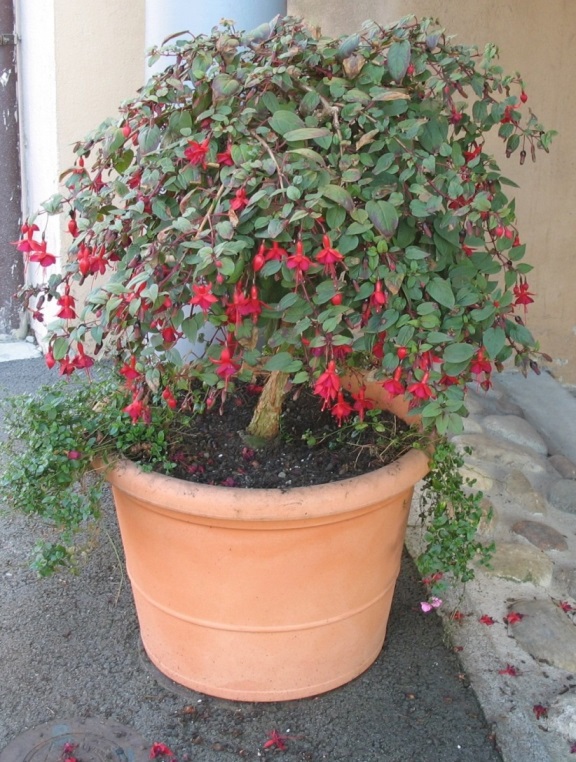
Fuchsia flowers are like bejeweled pendants (pendulous) and they for sure are a cause for happiness, ergo evolution must have had a plan about it all. Fuchsias flower throughout the summer and autumn, and all year with tropical species. In many Fuchsia species the sepals are bright red and the petals are purple. These colors attract the hummingbirds that pollinate them. The pollinators of the plant are oligoleges.


Fuchsia blooms in May

Oligolecty means that the pollinators, usually bees, are specialized on a plant family and have the morphology that can effectively pollinate the flowers. Fuchsia is in the family Onagraceae that is characterised by flowers with usually four sepals and petals. Nearly all the bees that visit the flowers of Fuchsia are oligoleges specialized on plants in the family Onagraceae.

I don’t know if these bees exist where the plants are cultivated. Other means of propagation may be used.

Fuchsia is a genus of flowering plants that consists mostly of shrubs or small trees. The first, Fuchsia triphylla, was discovered on the Caribbean island of Hispaniola (present day Dominican Republic and Haiti) about 1696–1697 by the French Roman Catholic monk and botanist Charles Plumier during his third expedition to the Greater Antilles. He named the new genus after the renowned German botanist Leonhart Fuchs (1501–1566) (http://en.wikipedia.org/wiki/Fuchsia).

Fuchsia received its name officially around 1703 by Plumier who compiled his Nova Plantarum Americanum based on the results of his fourth plant-finding trip to America in search of new genera.


Most Fuchsia are native to South America with a few growing in north through Central America to Mexico and most are shrubs from 0.2-4 m tall. There are several that are native to New Zealand and Tahiti. A majority are tropical or subtropical.

The fruit of all fuchsia species and cultivars are edible. Fuchsias have become popular garden shrubs, and once planted they can live for years with a minimal amount of care.

There is a British Fuchsia Society that maintains a list of "hardy" fuchsias that are known to have survived a number of winters throughout Britain and to be back in flower each year by July.

In the United States, members of the American Fuchsia Society brought back approximately 50 plants to California from a trip to Europe in 1930.

This is a well-traveled plant.


  Photograph:Tülay Karayazgan

Monday, August 31, 2015

Mallow

Writing about my familiar plants has been an enriching experience which has helped me to become more knowledgeable about plants and gain a greater appreciation of the wealth of information in the field of botany. Many plants go through marvelous phases with the seasons not unlike a caterpillar turning into a butterfly. Some of them bear fruit I had not noticed before. Dissimilar looking plants can be genetically related. Sometimes their origins are in the far corners of the world.

There is always something to discover about plants. Looking up mallow in particular helped me realize the naivety that engulfed me formerly.


In Turkey I always saw mallow greens growing in abundance along road sides, in fallow fields and empty lots. I used to think that mallow was a non-flowering plant.

When I first moved to Canada I was astonished to see that mallow grew there too. I again didn’t see flowers. It took me a while to put two and two together. The lovely mauve-purple flowers with dark veins that I recognized and the green leaves used in many recipes belonged together. They were both mallow.


To think that because mallow was used as vegetable meant it wouldn’t have flowers was faulty perception all together. Typical of the city slicker in me to not think about the flowers vegetables come from. If vegetables didn’t flower, produce fruit and seed how would they propagate? For instance, eggplants grow from pretty little white to lavender flowers. I saw that eggplants had seed but I never thought how.


                        Shizhao(talk | contribs) 21 October 2005 http://commons.wikimedia.org/wiki/File:Eggplant_flower.JPG

The Turkish name for mallow is 'ebegümeci'. Ebegümeci is used as vegetable in Turkey. Its leaves can be stuffed with rice or minced meat to make dolma-‘stuffed’ mallow leaves just as vine leaves or they can be used to make an ‘olive oil’ dish like most other vegetables and herbs. These are mostly served cold. Many species of the plant are edible. In fact, the flowers and the seeds are eaten as well.

Recipe for ‘olive oil’ mallow:
Ingredients: 1 kg. mallow, 2 Tbsp. rice, 1/8 c olive oil, 1/2 c hot water,   2 onions diced, salt and pepper to taste, 1 tsp sugar.
Directions: Place diced onions, rice, olive oil, seasoning and sugar in a pot. Add largely chopped mallow. Add hot water and stir everything. Cook over high heat for a few minutes and then lower heat to medium and simmer (for about twenty five minutes) until everything is well cooked. If needed add water during cooking. Serve warm with yogurt.


I now know that the genus in the family Malvaceae, is widespread throughout the temperate, subtropical and tropical regions of Africa, Asia and Europe. It has moved on to America where it is considered an invasive plant.


The color mauve was given its name in 1859 after the French name for this plant, mauve des bois.

Malva is a genus of about 25–30 species of herbaceous annual, biennial, and perennial plants. The ones used in dishes in Turkey are mainly Malva Sylvestris and Malva neglecta. Both are known as common mallow. M. Sylvestris is also known as grand malva or high malva and M. neglecta is known as dwarf malva (http://en.wikipedia.org/wiki/Malva). The Turkish name ebegümeci may drive from the word 'gümeç' which means the hexagonal wax cell of a honeycomb which the leaves of the plant may resemble.

Monday, August 24, 2015

Plants

I wondered what the number of known plants was. The study of plants originated in prehistory as herbalism. Humans needed to identify edible, medicinal and poisonous plants. It was in the 18th century that steps were taken toward a unified hierarchical classification of plant species. In 1753 Carl Linnaeus (known as Carl von Linné after his ennoblement in Sweden) published his ‘Species Plantarum’ that remains the reference point for modern botanical nomenclature. Nomenclature means an international system of terms used in biology for kinds and groups of plants and animals.

One study gives the total number of described flora in the world as 268 650. Others have given as high a number as 350 000. The most agreed upon numbers seem to be between 300-315 thousand species of plants.

Plants or Viridiplantae, in Latin meaning green plants, are multicellular eukaryotes-organisms whose cells contain a nucleus and other structures (organelles) enclosed within membranes-of the kingdom Plantae. In biology the major taxonomic ranks of plants are as follows: Life, Domain, Kingdom, Phylum, Class, Order, Family, Genus, Species.

Plants form a clade, a single branch on the tree of life that includes the flowering plants, gymnosperms such as conifers, ferns, clubmosses, hornworts, liverworts, mosses and the green algae. Red and brown algae, the fungi, archaea and bacteria are excluded. Modern botany has become highly complex and detailed over the years.

Unlike common names, botanical or scientific names are applied to only one kind of plant. They typically consist of two words; the first is called the genus name, the second the species name. Together they define a single unique type of plant. The words that make up the scientific name of a plant all mean something. They are Latin or Latinized words. Sometimes they are the old Roman name for a particular kind of plant, Latinized words of other languages are also used, descriptive names or terms such as alba-white, sanguinea-blood-red, or names of people for which the plant was named such as Forsythia, Magnolia.

The rules for officially naming plants are established by botanists who gather periodically in International Botanical Congresses (IBC). The next one is scheduled to be held in Shenzhen, China in 2017.

The naming of plants is governed by the International Code of Nomenclature for algae, fungi, and plants (ICN) and the International Code of Nomenclature for Cultivated Plants (ICNCP, Cultivated Plant Code). There are systems of plant taxonomy and the latest APG III-Angiosperm Phylogeny Group III system was published in 2009.

Learning all this made me think of the earth’s past. A wide surface of the earth was covered with dense forests until humans began farming which required opening up land for cultivation and pastures. In time, logging, urban sprawl, human-caused forest fires, acid rain, invasive species and shifting agriculture brought about loss of old-growth forests. Natural causes such as forest fires, insects, disease, weather, and competition of species cause loss of forests also. Secondary forests with smaller trees developed instead. “Today, more than 75% of the world’s remaining old forests lie in three countries-the Boreal forests of Russia and Canada and the rainforest of Brazil” (http://en.wikipedia.org/wiki/Forest).

When trees go entirely marshes and wild flower patches arise. These can be so lovely. Many beautiful plants that are considered weeds grow in these places. I will quote Wikipedia in defense of the weeds that grow in wildflower patches and meadows.

“A weed is a plant considered undesirable in a particular situation. Examples commonly are plants unwanted in human-controlled settings, such as farm fields, gardens, lawns, and parks. Taxonomically, the term 'weed' has no botanical significance, because a plant that is a weed in one context is not a weed when growing in a situation where it is in fact wanted, and where one species of plant is a valuable crop plant, another species in the same genus might be a serious weed, such as a wild bramble growing among cultivated loganberries. Many plants that people widely regard as weeds also are intentionally grown in gardens and other cultivated settings. The term is also applied to any plant that grows or reproduces aggressively, or is invasive outside its native habitat.” (http://en.wikipedia.org/wiki/Weed)


In Kanata, Ottawa where my younger daughter lives I came across a lovely wild flower patch in July, 2014. About five days after I took these photos the field was dug up and a sales shed was in place for the sale of the condos that were going to be built there.


A lovely yellow ‘weed’ drew my attention.


Lotus pedunculatus (formerly Lotus uliginosus) is a member of the pea family Fabaceae. It is a perennial growing primarily in Western Europe and the Mediterranean coast of North Africa. It thrives in damp, open locations growing 20-80 cm tall, with leaflets 10-25 mm long and 10-20 mm broad. The ones I saw had six golden-yellow flowers 10–18 mm long forming an umbel at the tip of the upright stem.

The common name for it is a long one: Marsh birdsfoot trefoil.

Here was a plant that had travelled from Europe. Once I noticed this lovely little flower I started seeing it in the gardens and lawns all over Kanata.


Monday, August 17, 2015

Fig

As most religious books attest, the fig is a heavenly fruit, especially the ones that grow in the Aegean region of Turkey. The fig is native to Turkey and the Middle East where it has been sought out in the wild and cultivated since ancient times. Turkey is the number one producer of figs in the world.


                                                           Photograph: http://www.ontugfidancilik.com/

Ficus carica, ‘the common fig’ or just ‘the fig’ is a species of flowering plant in the genus Ficus, from the family Moraceae. Today it is widely grown throughout the temperate world, both for its fruit and as an ornamental plant.

The fig is a deciduous tree or large shrub with smooth white bark, growing to a height of 3-7 meters. Its fragrant leaves are 12–25 cm long and 10–18 cm across, and deeply lobed with three or five lobes. It is a dioecious plant meaning the female and the male parts are on separate plants.


Leaves and the immature fruit of the fig

The fruit of the plant is also called fig. There are very many cultivars of the fig and each is particular. I am going to talk about the fig I consider the most tasty, the yellow lob (sarı lop) from Aydın, Turkey. Turkey has been exporting figs since Ottoman times and the port of the Aegean region where the best figs grow was the port of Izmir which used to be known to the western world as Symrna, the city founded during the Archaic Period of Greece (800 BC – 480 BC). This led to the ‘Sarı lop’ figs being known as ‘lob of Symrna’ which then were called Izmir figs in Turkey as well. Actually, back in those days Aydın was the capital of a wider province that included Izmir and the sarı lop grew around Aydın. I’ve read in an article dated 2007 that the Aydın Chamber of Commerce had this special fig registered as Aydın fig that year and Aydın now has the patent for the best fig.

What we think of as the fruit is actually the flower of the fig. Called a syconium, it is a fleshy receptacle lined by numerous unisexual flowers on the inside. It is referred to as the false fruit in which the flowers and seeds are borne. The fruit is 3-5 cm long, with a green skin, ripening to yellow green in the lob. There are also light green and purple figs. The fruit of the lob is rounded and bigger than other figs. The Ficus carica has a milky sap that runs when the stems or the leaves of the tree are broken.

Some figs have both the male and the female fruit on the same tree but with the lob the male and the female are separate trees. The female requires pollination by a kind of wasp (Blastophaga grossorum) of the superfamily Chalcidoidea that can only be found in the Mediterranean region (in the 1900s they were imported to California). The following is a quote from Wikipedia but to truly understand the grueling process one would need to research it in detail: "The fertilized female wasp enters the fig through the scion, which is a tiny hole, the ostiole, in the crown. She crawls on the inflorescence inside the fig and pollinates some of the female flowers. She lays her eggs inside some of the flowers and dies. After weeks of development in their galls (plant structures formed as their own microhabitats), the male wasps emerge before females through holes they produce by chewing the galls. The male wasps then fertilize the females by depositing semen in the hole in the gall. The males later return to the females and enlarge the holes to enable the females to emerge. Then some males enlarge holes in the scion, which enables females to disperse after collecting pollen from the developed male flowers. Females have a short time (48 hours) to find another fig tree with receptive scions to spread the pollen, assist the tree in reproduction, and lay their own eggs to start a new cycle (http://en.wikipedia.org/wiki/Common_fig)". The wasps stay inside the fig, and with the seeds add to the crunch.

The fig flowers in March to April and the pollination takes place around June. The pollination of the fig is referred to as caprification. The word comes from the Latin caprificus which means wild fig or the fruit of the wild fig. Pollination by caprificus became ‘caprificare’ and caprification. Ficus carica v. caprificus is the male of the Ficus carica. Usually, the practice is to plant one male tree for about 200 female trees.

Fig has long been cultivated in Anatolia to be consumed domestically or to be exported in the dried form. With the increased ease of transportation fresh figs are being exported more and more.


The roots of the fig are strong and invasive. The fig can easily grow out of walls and stone. If a fig tree is planted near homes it can cause damage to the foundation. This has led to the coining of an expression, ‘planting a fig on the hearth’ which means to cause a household or family to suffer an unprosperous destiny or to hinder someone’s desired objective from coming true.

                       
                                                                                                                               Photograph: Mehmet Özçakır

In Ottoman times jam making was popular. There were 60 or more varieties of jam including eggplant, walnut and fig jams. No self-respecting housewife would ever neglect making her own jams and marmalades. Offering a spoonful of jam to a guest before coffee was practiced in every fine home. There are old families in Istanbul who still adhere to this tradition. Fig jam is made from the buds of the male fig tree called ‘iğlek’ in Turkish. Jam is also important breakfast fare.


                                                                                                        Fig jam

As a child I had the pleasure of climbing and eating figs right off the fig tree. I still remember the smell, the sap and the feel of the tree, its leaves and fruit. You cannot bite into the fruit before pealing it first. The wait makes the first bite even tastier. These days in Canada we can only get California figs sometimes called Calimnyra.