Monday, August 1, 2016

Freesia

Freesia flowers used to enchant me as a child with their sideway form. So out of the ordinary, so unusual they looked. So exotic.

Freesia is native to the eastern side of southern Africa, from Kenya down to South Africa. There are about 14 species of freesias.

Freesia is a genus of herbaceous perennial flowering plants in the family Iridaceae, first described as a genus in 1866 by the Danish botanist Christian Friedrich Ecklon (1795-1868) and named in honor of the German botanist and physician Friedrich Freese (1794-1878 /I have not been able to confirm the dates).

The flowers are zygomorphic which means that they grow along one side of the stem, in a single plane. How do they all end up facing upwards? Freesia stems have the unusual habit of turning at a right angle where the flowers begin. This causes the upper portion of the stem to grow almost parallel with the ground. The flowers bloom along the top side of the stalk, facing upwards. The fragrant funnel shaped flowers that are typically white or yellow bloom in the spring. As many as 8 of them bloom on a stem. The plants have 10-40 cm tall stems and just as tall sword shaped light green leaves.

The plants usually called freesias are derived from crosses made in the 19th century between F. refracta and F. leichtlinii. Today, cultivated hybrid forms of a number of Freesia species are the most common. They are named Freesia x hybrida syn. Freesia x kewensis.

The family is currently divided into four subfamilies but the results from DNA analysis apparently suggest that several more should be recognized. The subfamily Ixioideae, which contains nearly two thirds of the species, is mostly African and it contains most of the familiar genera including Freesia, Ixia, Gladiolus, Crocus and Watsonia. Species of the former genus Anomatheca are now included in Freesia.


Members of the family are perennial plants growing from a bulb, corm or rhizome. Freesias grow from a conical corm-a short thick solid food-storing underground stem-1-2.5 cm in diameter. Corms, bulbs and tubers of plants resemble each other.

There is not a lot of information on the internet about freesias and what I could find was too specialized.

All this leaves us with the idea that we can only enjoy them just as I did when I was a child.

Monday, July 4, 2016

Daucus carota

Recognized as Queen Anne’s lace or Bishop’s lace by its common names, Daucus carota flowers do indeed look as if they were lace. In fact, each of the flowers have a slightly different look as though different maidens worked on them.


The genus name Daucus comes from daukos, name given by the Greeks to some members of plants having multi flowers in umbels-with short flower stalks which spread from a common point. The species name, carota originates from the Greek word carotos meaning carrot.

Daucus carota is a flowering plant in the family Apiaceae (or Umbelliferae), native to temperate regions of Europe and Southwest Asia, and naturalized to North America and Australia. Domesticated carrots are cultivars of a subspecies, Daucus carota subsp. sativus. In the 15th century, Dutch horticulturalists developed a thicker, sweeter root and exported the carrot to England where it became a popular vegetable.

Like the cultivated carrot, the D. carota root is edible while young, but it quickly becomes too woody to consume. The seeds are said to have a strong taste if used as a seasoning. Some say the flower clusters can be French-fried as a gourmet treat.

The wild carrot is an herbaceous, biennial plant that grows between 30 and 60 cm tall. It has a stiff, solid stem. The leaves are tripinnate-having three pinnate-ferny looking divisions. Hundreds of tiny white flowers are produced in flat-topped, two to four-inch umbel clusters. They may have a red or dark blue central flower. The function of this tiny central flower colored by anthocyanin-any of various soluble glycoside pigments producing blue to red coloring in flowers and plants-is to attract insects.

                    
As the seeds develop, the whole flower curls up at the edges, becomes more congested, and acquires a concave surface. Gradually it turns brown. The fruits are oval and flattened seeds and they have hooked spines. The dried flowers detach from the plant, becoming tumbleweeds.


Queen Anne’s Lace has a cousin: Ammi majus looks almost identical but it is more delicate and less weedy. The flowers lack the dark central dot. We are told that it’s easier for gardeners to grow and fits more easily into a cultivated garden border.


Ammi majus, Johann Georg Sturm, 1796

Queen Anne’s Lace is also similar in appearance to many other plants in the Parsley family, some of which are highly poisonous: Water hemlock (Cicuta maculata), poison hemlock (Conium maculatum) and fool's parsley (Aethusa cynapium). It was poison hemlock, that Socrates was compelled to take (http://www.seedaholic.com/daucus-carota.html).


A 19th century illustration of poison hemlock

In addition, the leaves of the wild carrot itself can cause phytophotodermatitis, so caution should be used when handling the plant.

Phytophotodermatitis, also known as "Lime Disease" (not to be confused with Lyme Disease), is a chemical reaction which makes skin hypersensitive to ultraviolet light. Sometimes mistaken for hereditary conditions such as atopic dermatitis or chemical burns, the reaction is caused by contact with the photosensitizing compounds found naturally in some plants and vegetables. Symptoms can be burning, itching, stinging, and large blisters that slowly accumulate over time.

The reaction typically begins within 24 hours of exposure and peaks at 48–72 hours after the exposure.


Daucus carota is a common sight in dry fields, roadside ditches and open areas. It is a natural addition to a wildflower meadow. Like most members of its family, D. carota attracts wasps to its small flowers in its native land; however, where it has been introduced, this does not seem to occur often enough. Some sources indicate that D. carota can be used as a companion plant to crops. This species is documented to boost tomato plant production when planted nearby, and it can provide a microclimate of cooler, moister air for lettuce, when intercropped-grown together-with it.

Old herbal books tell us that the whole plant was traditionally used for numerous ailments from gout to contraception.

However, the USDA (USA Department of Agriculture) lists it as a noxious weed, and it is considered a serious pest in pastures. It persists in the soil seed bank for two to five years.


There are many explanations for the origin of the common name Queen Anne's Lace. Both Anne, Queen of Great Britain 1665-1714, and her great grandmother Anne of Denmark are taken to be the Queen Anne for which the plant is named. One legend has it that the red flower in the center is thought to represent a blood droplet where Queen Anne, the British monarch, pricked herself with a needle when she was making the lace (https://en.wikipedia.org/wiki/Daucus_carota).

The fairy tale Snow White begins in a similar fashion, doesn’t it? A beautiful young queen sits sewing at an open window during a winter snowfall when she pricks her finger with her needle, causing three drops of red blood to drip onto the freshly fallen white snow on the black windowsill.

John Parkinson (1567–1650 perhaps the last of the great English herbalists writes in his Paradisus Terrestris, published in 1629, that the roots of D. carota boiled in salted beef broth are eaten with great pleasure because of the sweetness of them. “Parkinson goes on to talk about the fashion of wearing the foliage of Daucus carota in place of feathers on sleeves and hats. Since Parkinson was herbalist to Queen Anne’s husband, James I, the link between the plant and the Queen seems clear. And paintings of the era show Anne wearing lace as exquisite as the flowers that bear her name” (http://www.seedaholic.com/daucus-carota.html).

The entire plant can be harvested in July when flowers bloom, and dried for later herbal use. The edible roots and shoots need to be collected in spring when they are tender. The seeds form in autumn.

Wednesday, June 1, 2016

Poplar breezes

‘Poplar breezes blowing over one’s head’ is an expression that can be described but does not translate easily into English. ‘Başında kavak yelleri esiyor’ in Turkish, the expression is used to refer to youth acting irresponsibly, living an indulgent and merry life. It can also denote having unrealistic aspirations.

What gives root to the expression is the fact that poplar leaves characteristically flutter in the slightest breeze, because of their flexible flat petioles (leaf stalks). The leaves are alternate and oval or heart-shaped in outline, with finely to coarsely toothed margins (leaf edges). Shape and size of leaves may vary even on the same poplar tree.


Poplar is a deciduous tree that belongs in the family Salicaceae. There are around 35 species of poplar trees that differ in size, shape of the leaves, color of the bark and type of habitat. Poplar tree can be found throughout northern hemisphere (North America, Europe, Asia and North Africa). It is a rapid-growing but relatively short-lived tree.

Poplar grows mostly in temperate climates. It requires enough moisture, direct sunlight and soil rich in nutrients. Poplar tree is often found near the rivers, ponds and swamps.

Five types of poplar, one of which is a hybrid grow naturally in Turkey. These are: Populus alba, Populus euphratica, Populus nigra, Populus tremula, and Populus x canescens (P. alba x P. tremula). The genus name Populus, we are told, refers to the fact that the trees were often planted around public meeting places in Roman times. The Latin word for people is ‘populus’.

In her wonderful book Eating Dirt (Graystone Books, 2011), Charlotte Gill writes:

“Planting trees is the opposite of instant gratification, since you must wait for each little sapling to show its signs. There are no guarantees against failure. All over the world the task is basically the same. From eucalyptus in Brazil to the cedars in British Columbia to the teak plantations of Southeast Asia. There is something very old about the ritual, some kind of penance in the genuflection.”

The penance must come from the fact that we started by bringing down the primary forests of our world and we are still cutting more of nature than we ever let grow.

The poplar growers of Savur near Mardin in Southeastern Turkey must know what it is like to grow trees.


                                                                     Savur, Mardin-a poplar lumber yard

One of the biggest poplar forests is found in Terme, Samsun in Turkey. Poplar wood is exported to all parts of the world from Terme.

The wood of poplar is relatively soft and hence is mostly used to make cardboard boxes, crates, paper, and veneer. Due to high elasticity, poplar tree is the most important tree in the industry of snowboards. It is also used in the manufacture of musical instruments such as guitars, drums and violas.


The two well-known poplar species of Eurasia are the white and the black poplar. The white poplar (P. alba)-also known as silver poplar for its leaves which have white felted undersides-is columnar in form, reaching 30 meters in height. The black poplar (P. nigra) is long-trunked, and grows to a height of 35 meters. This poplar is endangered due to habitat destruction.


                                                           A mighty poplar resident of Istanbul


Poplars are dioecious plants. Their male and female flowers grow on separate trees and bloom in drooping catkins (pendulous unisexual flower clusters) before the leaves emerge, to facilitate wind pollination. The fruits are small thick-walled capsules that contain many minute seeds clothed in cottony tufts of silky hairs. The seeds are often released in great quantities, and the fluffy seed hairs assist in wind dispersal.
Image: http://www.geograph.org.uk/profile/3972 
SU9749 : Poplar Catkins


                                     P. nigra                                                                               P. tremulus
https://commons.wikimedia.org/wiki/File:Populus_nigra_-_K%C3%B6hler%E2%80%93s_Medizinal-Pflanzen-112.jpg   and
                                                                                                                                    http://commons.wikimedia.org/wiki/File:376_Populus_tremula.jpg

The bark of poplar tree can be white, light green, brownish or grey in color. It can be smooth in younger trees or covered with deep ridges in old trees.


Wood of poplar trees is used for panel painting. One of the most popular paintings of all time-Mona Lisa-was painted on poplar.


Monday, May 2, 2016

Chickpea

Ah, chickpeas, how do I love them? Let me count the ways. I love chickpeas as appetizers; as a snack; as a dip; in a salad or as a main dish.


                                                          Chick pea and its pod called 'çakıldak' or 'kapçık' in Turkish

Chickpeas as a snack are called leblebi in Turkish. Record of the origins of leblebi are scarce, though it is thought to date back to around 1370-90 CE in Turkey. Leblebi is roasted chick peas. There are two different kinds of leblebi: Dehulled leblebi is called 'sarı leblebi' (yellow leblebi) or rarerly, 'Girit leblebi' (Girit-the Island of Crete).


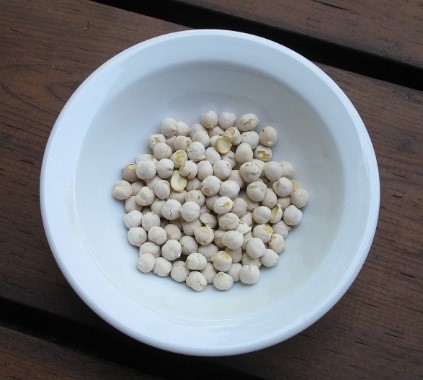
Non-dehulled leblebi is 'beyaz leblebi' (white leblebi) or 'nohut' (the word for chickpea in Turkish).


The first geographically registered (in 2002) leblebi is the Çorum leblebi from the town of Çorum. There are 2 other registered leblebi: Tavşanlı (Kütahya) leblebi (in 2003) and Serinhisar (Denizli) leblebi (in 2009).

Centers that have played a role in the production or are currently producing the most leblebi, starting from south east Turkey and going counter-clock-wise, are Mardin, Kayseri, Kirşehir, Denizli, Çorum, Amasya, Tokat and Erzincan. In Çorum mostly yellow leblebi is produced. White leblebi is produced in the Aegean Region of Turkey.


Evliya Çelebi, (25 March 1611-after 1682) an Ottoman Turk who travelled through the territory of the Ottoman Empire and neighboring lands over a period of forty years, recording his commentary in a travelogue called Seyâhatnâme tells that in the 17th century Istanbul, leblebi was produced and consumed in abundance. There were 100 shops and 400 workers making leblebi. The population of the city at the time is estimated to be 700,000-800,000.

The word leblebi may have come from the Arabic word 'leblab', a kind of ivy with edible seeds, thus 'leblebi' is 'made from leblab' or from the Persian 'leb', meaning lip, and suffix-i, 'of lips', thus leblebi is ‘for lips’ perhaps.


Cicer is a genus of the legume family Fabaceae (formerly Leguminosae), subfamily Faboideae and the only genus found in tribe Cicereae. Its best-known and only domesticated member is Cicer arietinum, the chickpea. The word legume means a plant in the family Fabaceae, or the fruit or seed of such a plant. This variety of plants (lately called pulses) have pods that contain seeds. Beans and peas are examples of legumes. Legumes are used for food, feed or as soil-improving crops due to their root characteristic.


The delicate chickpea flowers are produced singly or in pairs and can be white, pink, purple or blue in color.

The chickpea is thought to have originated in Turkey, Syria and Iran (http://www.kew.org/science-conservation/plants-fungi/cicer-arietinum-chickpea). It is one of the earliest cultivated legumes: 7,500-year-old remains have been found in the Middle East. Domesticated chickpeas have been found in the aceramic levels (without pottery) of Jericho and in Çayönü in Turkey. They were in Neolithic pottery at Hacılar, Turkey. They were found in the late Neolithic period (about 3500 BCE) at sites in Greece. In southern France, Mesolithic layers in a cave at L'Abeurador, Aude (south-central France) have yielded wild chickpeas carbon dated around 6790 BCE.

Chickpeas are mentioned in Charlemagne's Capitulare de villis (about 800 CE). Albertus Magnus, a 13th century Bishop mentions red, white, and black varieties in his writings.

Wikipedia lists the following kinds of chickpeas:
'Desi' which has small, darker seeds and a rough coat is grown mostly in India and other parts of the Indian subcontinent, as well as in Ethiopia, Mexico, and Iran. 'Desi' is probably the earliest variety because it closely resembles seeds found on archaeological sites and the wild ancestor of domesticated chickpeas, which only grows in southeast Turkey, where it is believed to have originated.

'Bambai' chickpeas are also dark but slightly larger than 'Desi'.

'Kabuli' is lighter colored, larger, and with a smoother coat, and is mainly grown in the Mediterranean, Southern Europe, Northern Africa, South America, and the Indian subcontinent.

An uncommon black chickpea, ceci neri, is grown only in Apulia, in southeastern Italy. It is larger and darker than the 'Desi' variety.

Green chickpeas are common in India.


Chickpeas used for leblebi are selected for shape, size, color, and harvesting time, and vary by cultivar. Generally, large-seeded (8 –9 mm in diameter), lighter-colored, round, and smooth surfaced kabuli chickpeas are preferred; a thick seed coat and hull, easy to remove from the kernel is requisite. Harvesting time determines the tempering process and quality of leblebi; chickpeas are cleaned and classified by size, with undeveloped, damaged, shrunken, and broken chickpeas discarded (https://en.wikipedia.org/wiki/Leblebi).

Leblebi is produced through a long and laborious process. To begin with, the chickpeas are heated (tempered) in special ovens  3 times on 3 separate days. After the third heating they are spread out to rest. This process takes approximately 15-20 days.

The night before leblebi is going to be made the chickpeas are dampened. The following day they are warmed in the special pan and lightly pressed with what is called a ‘mafrak’ (also known as tokmak or varak, a cylindrical piece of preferably poplar wood that is at least 30 cm in diameter) to get the skins off. During this process some chickpeas brake into two halves. These are separated by the use of a sieve from the whole chickpeas.

‘The broken leblebi’ are turned into leblebi flour. If the rest of the leblebi is roasted one more time little black specks appear on the chickpeas. They are then called ‘çifte kavrulmuş’-‘double roasted’ which is an expression often used within the Turkish food industry. Tea biscuits or Turkish delight-lokum can be double roasted, for instance.

Chickpea flour is gluten free and therefore can be consumed by people who have Celiac disease.

There is also a wide variety of types of leblebi that I don’t care for. It is said that there can be up to forty kinds of leblebi such as chocolate covered, sugar coated, peppered, candied, with mastic, with clove, etc. Leblebi has been introduced to North Africa, the Middle East, Europe and even North America.


The Armenian-Turkish composer Dikran Tchouhadjian (1837-1898) composed an operetta titled Leblebidji Hor-Hor Agha (The Chickpea Vendor Hor-Hor Agha) in 1875.

Chickpea and beef stew goes well with rice.

                          
For a tasty hummus, all you need is chickpeas, tahini (paste made from toasted, hulled, ground sesame seeds), garlic, sea salt, extra virgin olive oil and lemon juice.

Chickpeas are a good source of fiber, protein and iron making them desirable in a vegetarian diet. They have a mild, subtle taste that pairs well with many other ingredients.

Wikipedia informs us that the name chickpea traces back through the French chiche to cicer, Latin for 'chickpea'. The Oxford English Dictionary lists a 1548 citation that reads, "Cicer may be named in English Cich, or ciche pease, after the Frenche tongue." The dictionary cites chick-pea in the mid-18th century; the original word in English taken directly from French was chich, found in print in English in 1388.

The word garbanzo came first to American English as garvance in the 17th century, from an alteration of the Old Spanish word arvanço, being gradually anglicized to calavance. The current form garbanzo comes directly from modern Spanish. It’s been suggested that the origin of the word may derive from a Greek word or possibly, from two Basque (a non-Indo-European tongue) words forming a compound meaning dry seed.


I must say that chickpea coffee would not make the list of how I love chickpeas. In the early fifties I remember the scarcity of certain items. The lack of one of these, coloring pencils, concerned me in particular until the stationary my aunt frequented to get me story books received several boxes of them. About the lack of good coffee in those days I was informed later. Ground chickpeas would be added to the little amount of coffee there was and boiled. How could this satisfy any true coffee drinker? I guess at a time when there was no alternative they had do make do.

In 1793, ground-roast chickpeas were noted by a German writer as a substitute for coffee. In the First World War, they were grown for this use in some areas of Germany.

People still seem to brew chickpeas instead of coffee around the world. All that needs to be done is roast some chickpeas in a 300 degree oven until they're the color of roasted coffee beans, then grind the nuggets to the consistency of percolator-type coffee. I wouldn’t know.


                                                                                           Dry chickpeas

Monday, April 4, 2016

Lamium purpureum; a flower for my mother

In April 2015, as my mother lay in bed for the last ten weeks of her life, spring brought flowers to the park lawns, empty lots and road sides in Istanbul. One in particular, a small plant with purplish pink flowers that I had not paid much attention to before, was abundant that spring. I dedicated it to my mother’s spirit and observed it for much needed solace.


Lamium purpureum is an annual plant that flowers from April to November. It carpets huge areas and grows to be quite lush in fertile soil. It is a short lived plant but it will grow and flower even in the winter with mild temperatures. It is placed in the family Lamiaceae, the mint family. It grows to 20-30 cm tall.

                                             http://commons.wikimedia.org/wiki/File:Cleaned-Illustration_Lamium_purpureum.jpg

Being a member of the mint family we see that its stem is square or four sided instead of round or cylindrical and the stem and the leaves are covered in hairy down. The leaves are simple and opposite.


The leaves are green at the bottom and have a purplish shade at the top of the plant; they are 2-4 cm long and broad, with a 1-2 cm petiole (leaf stalk), and wavy to serrated margins.

Many species in the mint family are also aromatic. Basil, rosemary, lavender, marjoram, thyme, savory sage, together with mint, peppermint and spearmint are from the same family as L. purpureum. There are a handful of other plants with square stems and opposite leaves as the Mints but those plants are found in the Loosestrife, Verbena and Stinging Nettle families and none of them smell minty and spicy. The common name for L. purpureum is ‘red dead-nettle’ indicating it’s similar in look to nettle but that it does not sting.

The flowers are special. They have five sepals, parts of the flower that protect the bud and support the petals when the flower is in bloom. The sepals are fused together so that only the tips of them are separate. The five petals are also fused together but in an asymmetrical or irregular way. L. purpureum has a top hood like petal, two short ones on the sides and two lower lip petals. Typically, inside the flower there are four stamens, the reproductive organs, with one pair longer than the others.


The flowers are zygomorphic which means having floral parts unequal in size or form so that it is possible to divide the flower into essentially symmetrical halves by only one longitudinal plane passing through the axis.

The more I learned about this plant the more I knew how well it suited my mother. My beautiful mother did not have high ambitions other than to be with her family. She was a woman of simple tastes. She knew to waste not and want not. She loved nature and she always had cut flowers in her vases. She would have enjoyed this useful and unassuming plant with the small pink flowers in her home.

Any member of the Mint family can be safely eaten. With L. purpureum the entire plant is edible. The nature and botany author Thomas J. Elpel tells us that the plant tastes a little grassy but the flavor is rather mild. The plant is highly nutritious, abundant in iron, vitamins, and fiber. The oil in the seeds is high in antioxidants. And the bruised leaves can be applied to external cuts and wounds to stop bleeding and aid in healing. Elpel recommends that the best way to eat large quantities of this plant is to blend it into a smoothie.

My mother was blessed with an abundance of fruit and vegetables in her diet since her childhood. She ate a rich variety of natural foods that she cooked herself. She did not waste. I wish, together, we could have tried out L. purpureum smoothies.


The flowers are loaded with nectar. This allows bees to gather the nectar for food when few other nectar sources are available. It is also a prominent source of pollen for bees in the spring when bees need the pollen as protein to build up their nest. In turn, the flowers are pollinated by bees.

The plant has medicinal properties. The whole plant is said to be astringent, styptic, diaphoretic, diuretic and purgative which all sound like remedies that help to detoxify the body. One way of consuming the plant is to add one tea spoon full of chopped L. purpureum to a glass of water in a pot and bring it to a boil, steep it until it cools and strain. Drink it three times a day between meals. The drink can be sweetened with honey.

27 species of Lamium are found in Turkey. L. purpureum is a species which has spread all over the world. As with many plants, outside of its native range, it is a common weed of cultivated areas; it is listed as an invasive species in some parts of North America.


One of many quotes from Vincent Van Gogh goes, “If you truly love nature, you will find beauty everywhere”. My mother was a tolerant, peace loving and graceful woman who was always appreciative of what life had presented her. I believe her true love of nature helped her see beauty everywhere. 
   
A picture of my mother taken in 1974